For six years I have been building my second brain in Obsidian, following Zettelkasten.
Note by note, at my own pace. I read, I summarized, I connected. It is not an archive, it is where my knowledge memories live: six years of everything I read, studied and thought, each idea in an atomic note linked to the others.
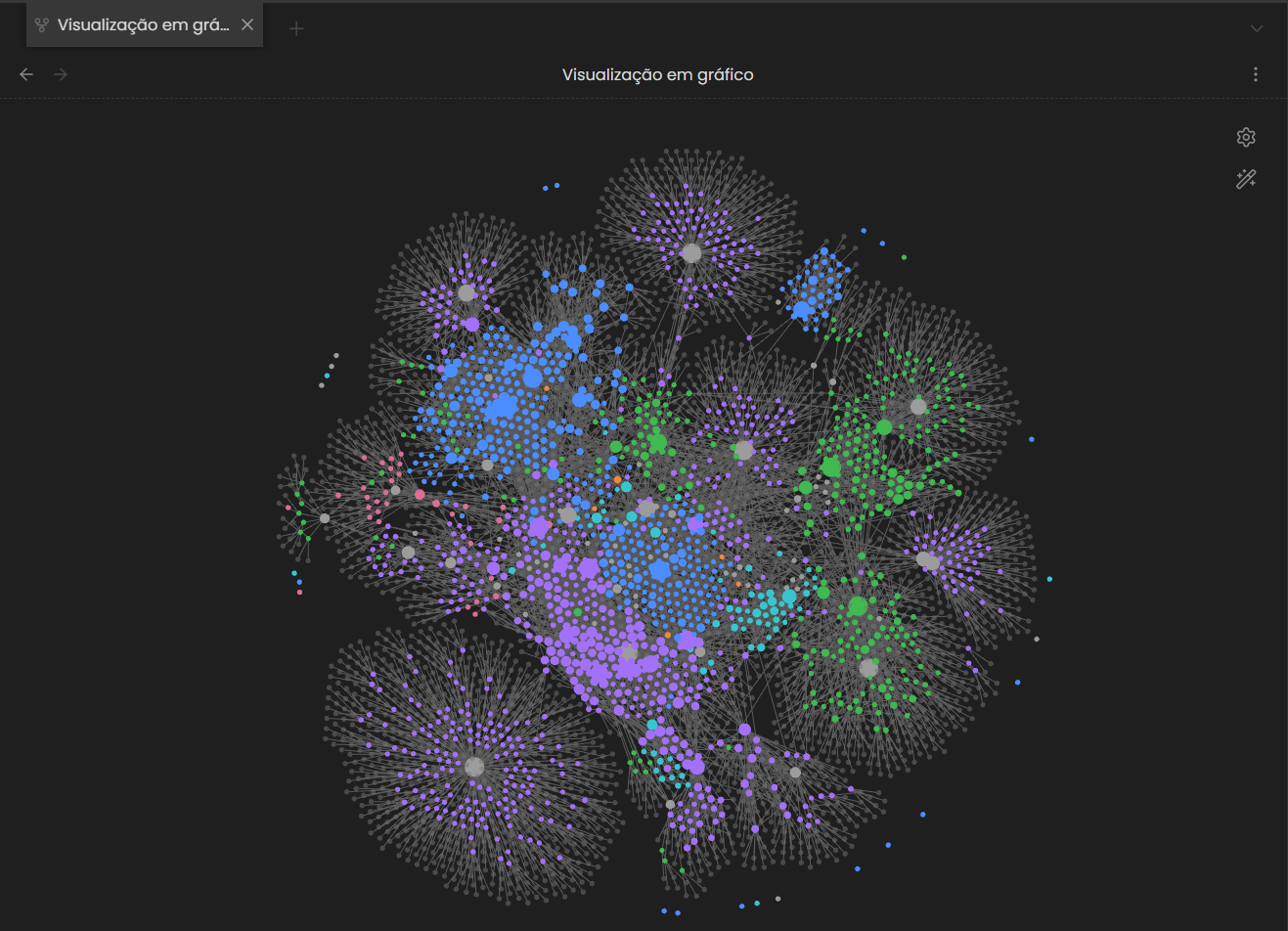
Today it holds almost 2,700 notes, 1,392 literature notes, 77 content maps and nearly 21 thousand connections between them. I wrote all of it. And I still cannot remember all of it at once.
That is not a flaw of mine. It is the limit of any large memory.
What Zettelkasten solves, and what it does not
Zettelkasten is beautiful precisely because of this: each note is an atomic memory, small, linked to its neighbors. That is why I chose the method. It stores knowledge the way the mind works, by association, not by folder.
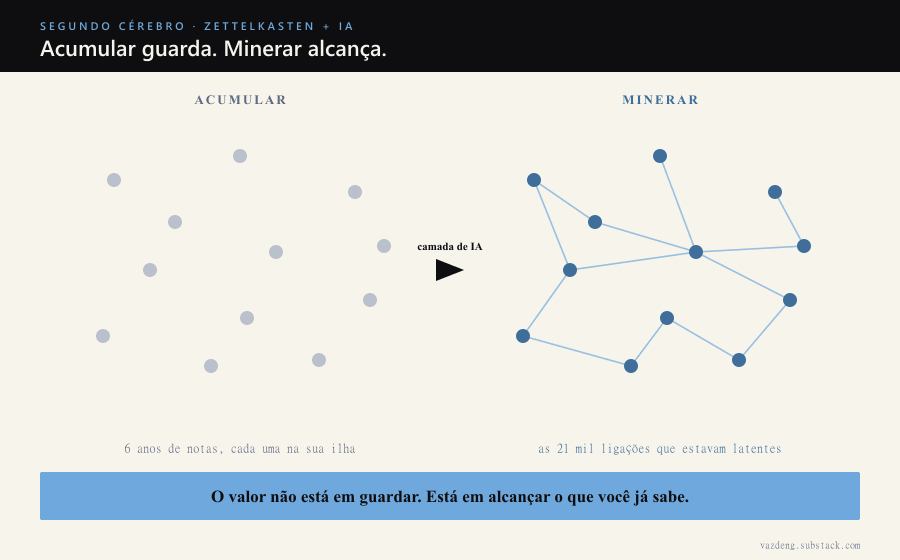
But there is a human limit. When you accumulate six years, the base knows more than your head can reach at any given moment. You wrote about one topic today, about another three months ago, and the two memories rarely find each other on their own. It is not that they disappeared. It is that you cannot hold all the connections at the same time.
Storing memory, Zettelkasten does very well. Reaching all of it at once, that is where the mind cannot keep up alone.
What AI changed
AI did not come to write my notes. It came to help me remember them.
Karpathy, co-founder of OpenAI, popularized in 2026 a pattern where the LLM organizes a knowledge base from the sources you keep. I took the mining part and put it on top of the Zettelkasten I already had.
In practice: when a new memory comes in, a transcript, an article, a paper, an agent reads it, writes the literature note and finds the old notes about the same subject on its own, creating the links. Then a second agent sweeps the entire vault looking for connections I had never made by hand, and proposes bridges between memories that had never met.
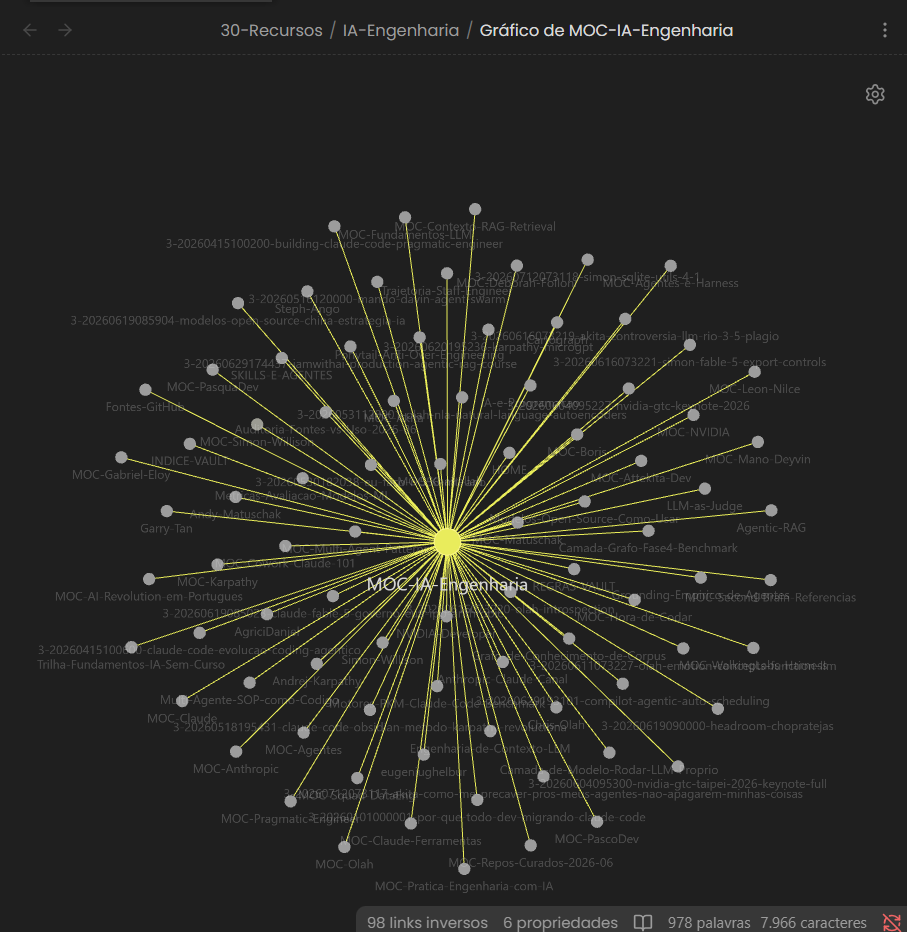
The result is those nearly 21 thousand connections. I wrote the notes over six years. The AI made visible the structure that was already latent in there, waiting for someone with infinite patience to cross everything with everything.
And then I can ask the question that used to be impossible: “what do I already know about X, considering everything I have ever studied?”. The answer does not come from the memory of a generic chatbot. It comes from six years of my own knowledge.
The compounding that only shows up when you connect
There is a truth about knowledge memory that almost nobody tells you: the value is not linear, it is compound.
The first note on a topic is worth little on its own. The thousandth is worth a lot, because it talks to nine hundred others. Each new memory refines what was already there. It is compound interest on knowledge.
But compound interest you cannot access just sits there. For six years mine kept accumulating. Being able to see all the connections is what turns accumulation into leverage: in decisions, in content, and yes, in income.
Two things are still mine
And they are exactly the ones that matter.
Curation: what gets in. No agent decides that a source becomes a memory of mine. That criterion is mine, and that is where the value lives.
And thinking. The note I write while thinking, the reflection, the half-formed idea. AI helps me remember and connect what I have already thought. Thinking is still me.
What the graph shows
The dense clusters up top, the links crossing in the middle between domains, became visible in the last few months, when the mining layer came in and lit up what was already there. The structure was always mine. The AI just let me see it whole.
If you have a large second brain, the question is not which plugin to install. It is whether you can reach everything you have already stored. Zettelkasten gave me the memory. AI gave me a way to access all of it.