The question I get most from engineers moving past senior is always the same one: “what do I need to do to reach Staff?”. The market’s standard answer is “write more code, take on more complex systems, become the technical reference”. I disagree. And I think that answer is what stalls more good careers than anything else.
Staff is not a more experienced senior. It is a different mental model of impact. Whoever tries to get there by doing more of what they already do as a senior usually gets stuck on the plateau. They become an excellent executor of scope, but never cross the boundary.
The boundary that separates the two
A senior receives a problem and delivers a solution within the given scope. A Staff engineer looks at the scope and asks: “why are we solving this? is there something more critical that nobody picked up?”. The difference is not technical, it is positioning. Senior optimizes inside the box. Staff redesigns the box.
This shows up in practical decisions. A senior receives a stuck project and makes it work. A Staff engineer looks at 3 projects stuck for a reasonable cause and proposes changing the prioritization process that produces systematic blockage. One solves, the other prevents.
Larson’s 4 archetypes (there are not 3)
Will Larson formalized the role in the book “Staff Engineer: Leadership Beyond the Management Track”. He describes 4 archetypes, not 3, and each one requires a different mix of skills:
Tech Lead. Guides the approach and execution of a specific team. It is the most common entry archetype, because every growing company needs this role. Works closely with 1 to 3 managers in a focused area.
Architect. Responsible for the technical direction and quality of a critical area over a multi-year horizon. Combines technical depth with organizational understanding. According to Larson, this archetype tends to appear only from ~100 engineers in the company onwards.
Solver. Jumps into arbitrarily complex problems and unblocks them. Some stay in one area for a long time, others hop from hotspot to hotspot as leadership asks. It is the most misunderstood archetype, because it looks like “senior firefighter”. It is not. It is a long-term problem owner in ambiguous territory.
Right Hand. An extension of a C-level executive or VP, operating with borrowed scope and authority. Only appears in large companies (~1000 engineers) and is usually an internal transition, not an open position.
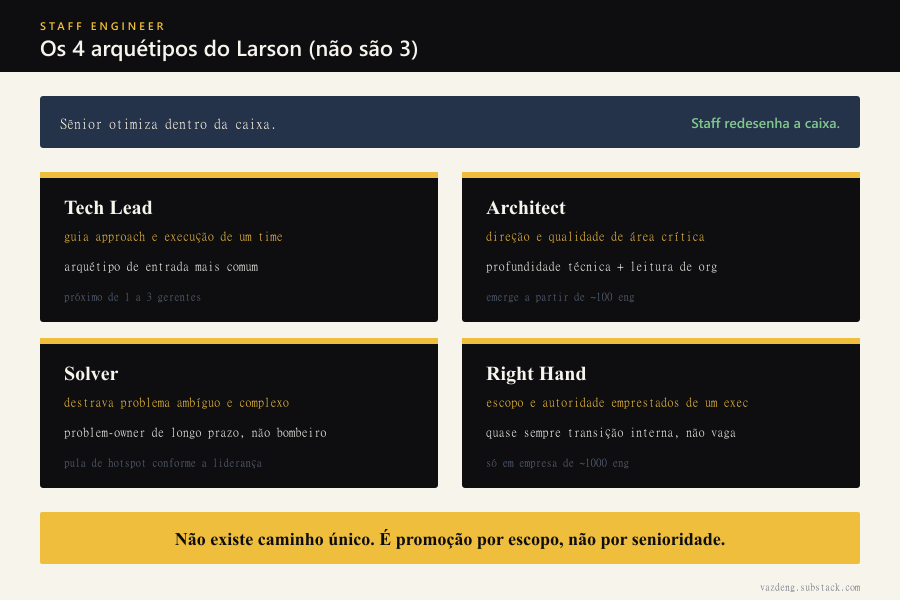
The mistake is believing there is a single path. There is not. Each archetype demands different skills, and your Staff career will depend on which one fits what you do best.
What nobody tells you about Staff in Brazil
In Brazil, most companies do not have Staff formally on the org chart. You become Senior 3 with Staff scope and Senior 2 salary. That is a fact, not a criticism. And it creates a trap: a Brazilian engineer studies Larson’s material and StaffEng.com, applies it at a company that does not recognize the role, and ends up frustrated.
The answer I adopted: the role does not depend on the title. If you are solving architecture problems in a critical area, you are an Architect. If you are unblocking stuck projects, you are a Solver. Formal recognition comes later, and sometimes it comes at another company. Do not wait for the promotion to start acting. Start acting and the promotion becomes a consequence.
In the Brazilian market this shows up all the time: Staff here is frequently Senior+ with Staff scope, without the formal title. It is true. And it is an opportunity, because there is less formal competition for the title.
The anti-pattern I see the most
“I will become Staff by studying more technology.”
You will not. Staff is not about knowing more languages, more frameworks, more papers. It is about deciding what the team should be doing and sustaining that decision with technical and political evidence. Cross-team communication skills and architectural document writing weigh more than mastering one more stack.
This is not career-coach opinion. It is what Larson explicitly argues in the book, and it is what shows up in Staff interviews at large companies: they evaluate the ability to identify problems, not to solve presented problems.
If I had to boil it down to one decision
Senior optimizes execution of scope. Staff decides scope. The ones who move up are the ones who manage to shift from operation to direction, and sustain the shift with solid technical competence.
If you are in transition, three questions to self-diagnose:
- Which of Larson’s 4 archetypes looks most like what you already do today?
- What orphan problem on your team is waiting for someone to pick up, and nobody has because “it is not in anyone’s scope”?
- What was the last cross-team technical decision you documented in writing, for whoever comes after you?
If these three questions stalled you, you are probably still a senior operating well, not a Staff in transition. And that is ok. But do not confuse the two.